
The Ideas to Action origin story
How a simple insight sparked a movement in employee-powered innovation.
The Ideas to Action origin story began more than 35 years ago, on a sweltering July day in Tokyo, when I set out to unlock the secrets of Japanese quality. Inside a windowless conference room, I discovered a remarkable approach to continuous improvement powered by the people closest to the work.
That experience sparked a question: could this approach be adapted across cultures without taking years to learn? That question led to the Ideas-to-Action Process—a simpler, faster way for leaders to unlock frontline ideas and turn them into measurable results.
From frustration to breakthrough
Back in the U.S., I worked to implement TQM, Six Sigma, and Lean methods. Yet these initiatives often stalled at the front lines. Complex training and cumbersome processes were not connecting with the people doing the work.
Then a comment from a Toyota supervisor stayed with me: “Your workers have ideas, and they are not afraid to speak up. The difference is that we make it easy for our team members to share ideas because we recognize their profit potential.”
His words cut through the noise. The answer was not more complexity or bigger investments. It was making it easier for leaders to tap the energy that already exists at the front line—where employee-powered innovation begins.


Five foundational
leadership beliefs that fuel
employee-powered innovation
Over more than 35 years and 500 change efforts, we identified five leadership beliefs that consistently shape whether employee-powered innovation takes hold.
Start where the energy Is
Tap into employees’ natural motivation to improve their work by focusing on issues that matter to them and align with business priorities.
Empower effective action
Give teams the tools, authority, and structure to act on their ideas quickly.
Prioritize speed to results
Design for quick wins. Break down projects into short sprints with clear milestones.
Embrace simplicity
Avoid complex methods and jargon. Use intuitive tools and practical methods that make participation easy for everyone—avoid complex methods and jargon
Make the leap of faith
Trust the collective genius of your workforce and create a safe space for ideas to surface and grow.
The Ideas-to-Action Process—
speed, simplicity, and results
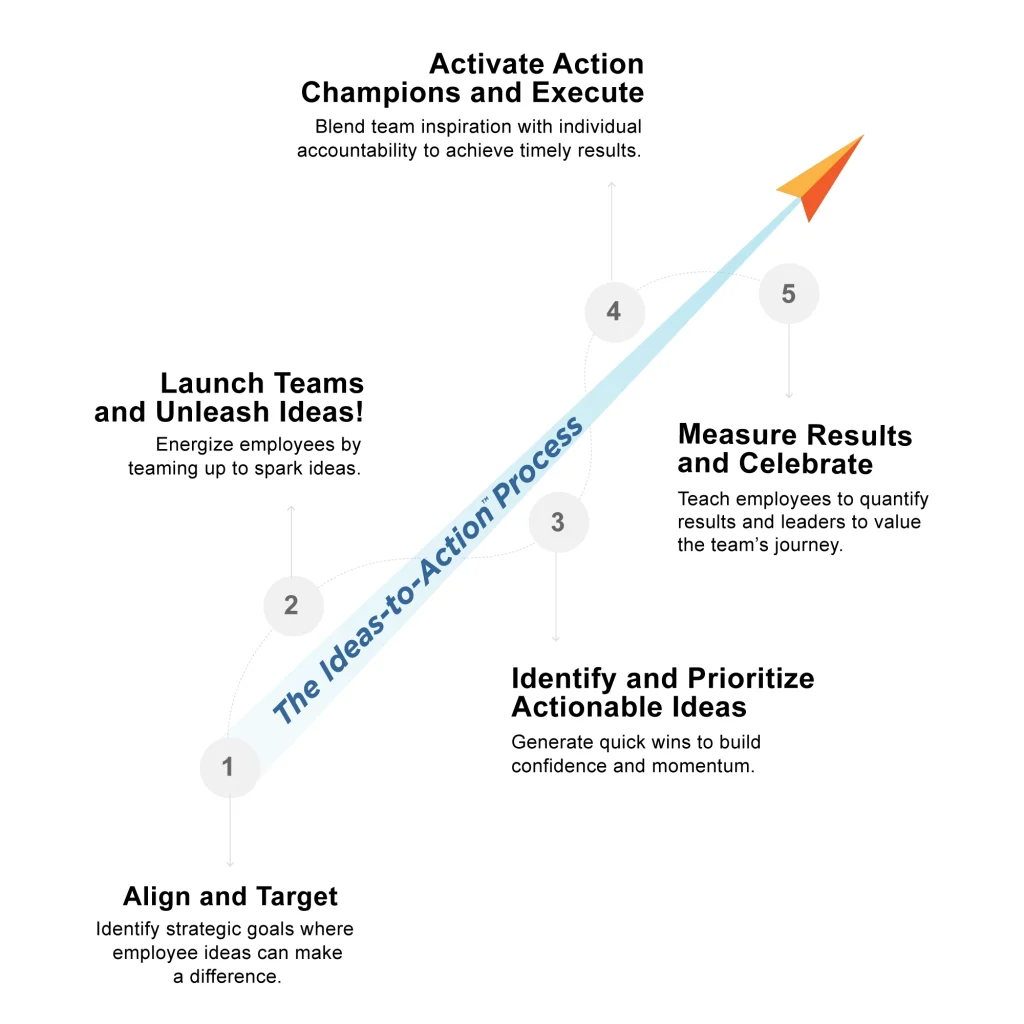
The Ideas to Action origin story ultimately became the Ideas-to-Action Process—a practical framework for turning frontline ideas into measurable results.
Grounded in the five foundational leadership beliefs, the Ideas-to-Action Process gives leaders a practical, repeatable way to unlock frontline ideas and turn them into measurable results—without lengthy training or expensive consultants.
Built for teams of 5–8 people, the process uses simple tools any leader can facilitate. Its 60-day sprints create quick wins, clear milestones, and the momentum to sustain change.
Organizations across industries have used the process to accelerate execution, build momentum, and achieve better, faster results.

What change leaders say about
the Ideas-to-Action Process
“The Ideas-to-Action Process is the way to make change happen faster with the best consultants already on your payroll—your frontline employees!”
— John Biedry, Executive Leader and Ideas-to-Action Process Champion,
Nike, ServiceMaster, USPS, and Waste Management