
When Frontline Teams Present Results, Honor More Than the Numbers

Leadership recognition in frontline innovation matters most when the team stands in front of senior leaders and presents what it achieved. That moment can look simple from the outside. A few slides. A few numbers. A team report. A leader response. But in the book Ideas to Action, presenting results is a pivotal moment for […]
Time Is the Enemy of Frontline Change Motivation

Frontline change motivation does not usually disappear all at once. It drains while people wait. It drains while the initiative gets explained again. It drains while the team waits for the next meeting, the next approval, or the next planning cycle. Leaders may still believe the effort is alive because the program is moving through […]
Complexity Kills Frontline Change Momentum

Every organization has its own version of the impossible vault door. A change initiative launches with good intent. The problem is real. The stakes are clear. The frontline team has ideas worth hearing. Then the effort gets wrapped in specialized language, approval steps, training requirements, governance routines, and expert-dependent tools that make action feel harder […]
Why Engagement Alone Won’t Turn Ideas into Action

Change initiatives do not usually stall because they run out of ideas. They stall because the moment of contribution is not the same as the moment of authority. That distinction matters more than many leaders realize. A change initiative launches with energy. Teams are upbeat. Practical ideas for getting results surface quickly in the launch […]
Why Change Initiatives Are Still Failing at the Front Line

Most change initiatives are still failing for a simple reason: leaders keep treating an ownership problem like an engagement problem. For thirty years, organizations have tried to improve change outcomes with better communication, stronger engagement efforts, more training, and now faster technology. The language evolves. The tools improve. Yet at the front line—where execution either […]
Ideas-to-Action Video Newsletter Issue 5 | Avoiding the Frontline Change Trap
In this issue of the Ideas-to-Action Video Newsletter, author Rick Tucci revisits the rise and decline of Six Sigma to highlight a common leadership pitfall he calls the Frontline Change Trap. It’s what happens when methods become doctrine, overshadow frontline wisdom, and slow down progress. Drawing on stories from the heyday of Lean Six Sigma, Rick explains why methods must remain tools—not goals—and why frontline experience is often the fastest, most reliable form of data for accelerating change.
The Ideas-to-Action Q&A Series Issue 5: How Leaders Can Avoid the Frontline Change Trap
Many leaders turn to proven methods like Lean and Six Sigma to drive change. But when methods become doctrine, they can overshadow the wisdom of employees and stall progress. In this post, author Rick Tucci explains the Frontline Change Trap—and how leaders can avoid elevating process over results by balancing tools with frontline experience through the Ideas-to-Action Process™.
Conventional Change Management Is Broken: Fix It by Blending the Psychology and Science of Change
For decades, leaders have been told “change is hard” and fed a steady diet of conventional change management. But the track record speaks for itself: most initiatives stall, fade, or backfire. What if the problem isn’t employees resisting change, but leaders relying on the wrong playbook?
Ideas-to-Action Video Newsletter Issue 4 | The Impasse to Change (and Why It Doesn’t Have to Be So Hard!)
We’ve all heard it: “Change is hard.” But is it really? In this episode of the Ideas-to-Action Video Newsletter, Rick Tucci explains why traditional change management makes change harder than it needs to be—and how the Ideas-to-Action Process™ helps leaders break through the Psychological Impasse to Change by turning engagement into ownership.
The Ideas-to-Action Q&A Series Issue 4: The Impasse to Change (and why it doesn’t have to be so hard!)
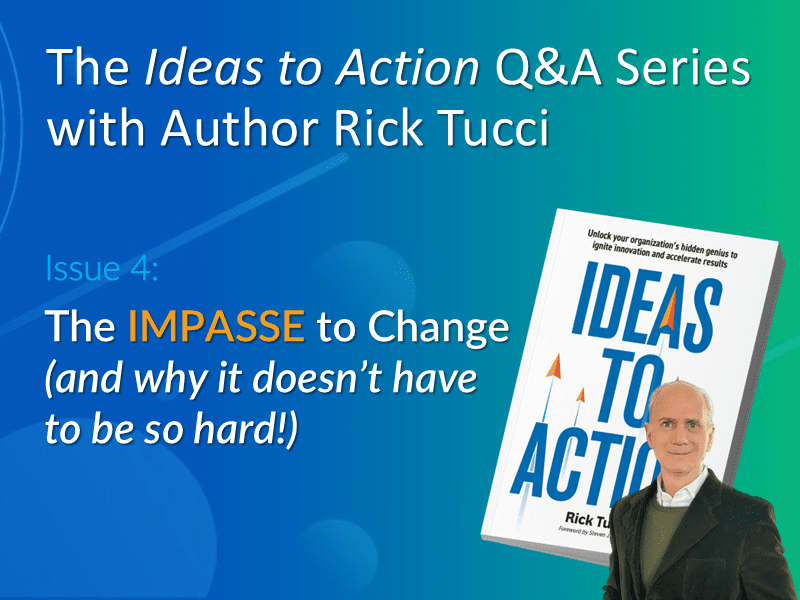
Most leaders say they want employee engagement, but too often change efforts stall. Why? Because engagement without ownership creates a cycle of frustration. In this post, author Rick Tucci explains the Psychological Impasse to Change—and how leaders can move beyond persuasion and the illusion of engagement to achieve real results with the Ideas-to-Action Process™.
________________________________________